Contents
Sin(mt)
Proof
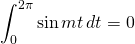
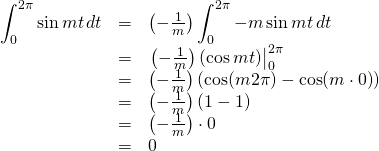
We need to find the antiderivative of  . We know that

So we don’t change the value of our original integral, we need to find a creative way of multiplying that expression by 1. The way to do it is to multiply our original expression by  . We get:
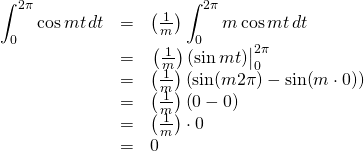
Cos(mt)
Proof
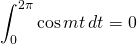
We need to find the antiderivative of . We know that

So we don’t change the value of our original integral, we need to find a creative way of multiplying that expression by 1. The way to do it is to multiply our original expression by  . We get:
Sin(mt)Cos(nt)
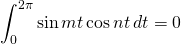
Proof
We need to make use of the product-to-sum trigonometric identity
![2\sin mt \cos nt\=\sin[(m+n)t] + \sin[(m-n)t]](https://www.samartigliere.com/wp-content/ql-cache/quicklatex.com-a60c1151bf27ed3225a7a14b2d5f4d3d_l3.png "Rendered by QuickLaTeX.com")
This stems from 2 sum-to-product trigonometric identities, the proofs of which can be found here:

Divide both sides of this last equation by 2. We get
![\sin m \cos n = \frac12\left[ \sin(m+n)+\sin(m-n)\right]](https://www.samartigliere.com/wp-content/ql-cache/quicklatex.com-e015bca65277e285432ffbb0a6aa3c3e_l3.png "Rendered by QuickLaTeX.com")
So,
![\begin{array}{rcl} \displaystyle\int_0^{2\pi}\sin mt \cos nt\,dt &=& \displaystyle\int_0^{2\pi} \frac12\left[ \sin(m+n)+\sin(m-n)\right]\,dt\\ &=& \frac12\displaystyle\int_0^{2\pi}\sin(m+n)\,dt + \frac12\displaystyle\int_0^{2\pi}\sin(m-n)\,dt \end{array}](https://www.samartigliere.com/wp-content/ql-cache/quicklatex.com-7053328b98daee85667ac1aa5ac63f61_l3.png "Rendered by QuickLaTeX.com")
Since  and
and  are both integers, then
  and
and  are integers. But we proved above that
![\displaystyle\int_0^{2\pi} \sin [(\text{integer})t] = 0](https://www.samartigliere.com/wp-content/ql-cache/quicklatex.com-0c167ac2c39aaa8682013c784e85d866_l3.png "Rendered by QuickLaTeX.com")
Therefore,
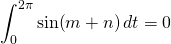
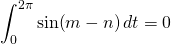
Thus,

Sin(nt) Sin(mt)
We have 2 things to prove here:
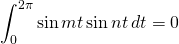 if integers
  or
or 
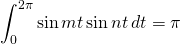 if
if 
Proof
To prove the above statements, we have to invoke another product-to-sum trigonometric identity:
![2\sin mt \sin nt\=\cos[(m-n)t] - \cos[(m+n)t]](https://www.samartigliere.com/wp-content/ql-cache/quicklatex.com-866e30e31ea3a27184044fbc2a991085_l3.png "Rendered by QuickLaTeX.com")
This stems from 2 sum-to-product trigonometric identities, the proofs of which can be found here:

Divide both sides of this last equation by 2. We get
![\sin m \sin n = \frac12\left[ \cos(m-n)-\cos(m+n)\right]](https://www.samartigliere.com/wp-content/ql-cache/quicklatex.com-42f77b557e9bfb64350e7f512ec2c2d9_l3.png "Rendered by QuickLaTeX.com")
So,
![\begin{array}{rcl} \displaystyle\int_0^{2\pi}\sin mt \sin nt\,dt &=& \displaystyle\int_0^{2\pi} \frac12\left[ \cos\left((m-n)t)-\cos[(m+n)t\right)\right]\,dt\\ &=& \frac12\displaystyle\int_0^{2\pi}\cos\left((m-n)t\right)\,dt - \frac12\displaystyle\int_0^{2\pi}\cos\left((m+n)t\right)\,dt \end{array}](https://www.samartigliere.com/wp-content/ql-cache/quicklatex.com-c82d8ddde515aef62016a6ee8552c251_l3.png "Rendered by QuickLaTeX.com")
There are 2 possibilities here. First,
If  then both and are integers. But we previously proved that
![\displaystyle\int_0^{2\pi} \cos [(\text{integer})t] = 0](https://www.samartigliere.com/wp-content/ql-cache/quicklatex.com-6ef4f1495b4eed9074da7c0794bc5136_l3.png "Rendered by QuickLaTeX.com")
Therefore,
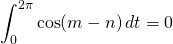
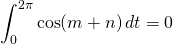
Thus,

In the second scenario where , will still be an integer so the righthand-most term, 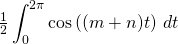 will be 0 and can be ignored.
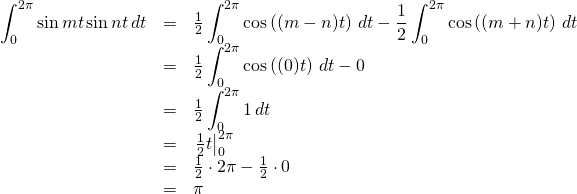
However, if ,  . That means that

Then
Cos(mt)Cos(nt)
Again, in this case, we have 2 things to prove:
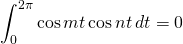 if integers or
 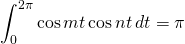 if
if
Proof
To prove the above statements, we have to invoke yet another product-to-sum trigonometric identity:

This stems from 2 sum-to-product trigonometric identities, the proofs of which can be found here:

Divide both sides of this last equation by 2. We get
![\cos m \cos n = \frac12\left[ \cos(m-n)+\cos(m+n)\right]](https://www.samartigliere.com/wp-content/ql-cache/quicklatex.com-5631ce8e6a4f7bc93578db39aeede838_l3.png "Rendered by QuickLaTeX.com")
So,
![\begin{array}{rcl} \displaystyle\int_0^{2\pi}\cos mt \cos nt\,dt &=& \displaystyle\int_0^{2\pi} \frac12\left[ \cos\left((m-n)t)+\cos[(m+n)t\right)\right]\,dt\\ &=& \frac12\displaystyle\int_0^{2\pi}\cos\left((m-n)t\right)\,dt + \frac12\displaystyle\int_0^{2\pi}\cos\left((m+n)t\right)\,dt \end{array}](https://www.samartigliere.com/wp-content/ql-cache/quicklatex.com-055fb076f4b9215ced2ed7c087f3e312_l3.png "Rendered by QuickLaTeX.com")
There are 2 possibilities to consider. First,
If then both and are integers. But we previously proved that
Therefore,
Thus,

In the second scenario where , will still be an integer so the righthand-most term, will be 0 and can be ignored.
However, if , . That means that
Then
