The integral we’re setting out to solve here is the so-called Dirichlet integral:
![\[ \int_0^{\infty}\frac{\sin x }{x} \quad \text{(1)} \]](https://www.samartigliere.com/wp-content/ql-cache/quicklatex.com-e40140cf730770bbdf65b0a1ac7f43e5_l3.png "Rendered by QuickLaTeX.com")
We can’t solve this integral by the usual means. There are multiple methods of solving this equation. 5 such methods are outlined at proofwiki. The method we’ll use here is Feynman’s technique. The proof is taken from:
We need to find a way to get the x out of the denominator in the integrand. We do this as follows:
![\begin{align*} \int_0^{\infty}\frac{\sin x }{x} &= \int_0^{\infty}\frac{\sin x }{x}\cdot e^{-0x}\,dx = I(0) \quad \text{(2)} \\ I(b) &= \int_0^{\infty}\frac{\sin x }{x}\cdot e^{-bx}\,dx \quad \text{(3)} \\ \frac{d}{db}[I(b)] &= \frac{\partial}{\partial b}\left( \frac{\sin x }{x}\cdot e^{-bx} \right)\, dx \quad \text{(4)} \\ I^{\prime}(b) &= \frac{\partial}{\partial b}\displaystyle \left(\frac{\sin (x)\,e^{-bx}}{x}\right)\,dx \quad \text{(5)} \\ &= \displaystyle \left(-\frac{\cancel{x}\sin (x)\,e^{-bx}}{\cancel{x}}\right)\,dx \quad \text{(6)} \end{align*}](https://www.samartigliere.com/wp-content/ql-cache/quicklatex.com-b8b0198810ada816695200dd3a7ddc14_l3.png "Rendered by QuickLaTeX.com")
Now we’ve got the x out of the denominator of the integrand. Next, we need to integrate  .
.
We use integration by parts twice in a row. Recall, in integration by parts:
![\[ \int fg^{\prime} = fg - \int f^{\prime}g \]](https://www.samartigliere.com/wp-content/ql-cache/quicklatex.com-716429fdf1231350b5bc47f008ddbb00_l3.png "Rendered by QuickLaTeX.com")
First Integration by Parts:


So,
![\[\int_0^{\infty} e^{-bx}\,\sin(x)\,dx=\displaystyle -\frac{e^{-bx}\sin(x)}{b}-\int_0^{\infty} -\frac{e^{-bx}\cos(x)}{b}\]](https://www.samartigliere.com/wp-content/ql-cache/quicklatex.com-311f6ce3ac8ee7f057fb566c92815cf0_l3.png "Rendered by QuickLaTeX.com")
Second Integration by Parts:




Therefore,
![\begin{align*} \int e^{-bx}\,\sin(x)\,dx &= -\frac{e^{-bx}\sin(x)}{b} - \frac{e^{bx}\cos(x)}{b^2} - \int_0^{\infty} \frac{e^{-bx}\sin(x)}{b^2}\,dx \\ \int \frac{e^{-bx}\sin(x)}{b^2}\,dx + \int e^{-bx}\,\sin(x)\,dx &= -\frac{e^{-bx}\sin(x)}{b} - \frac{e^{bx}\cos(x)}{b^2} \\ \frac{1}{b^2} \cdot \int e^{-bx}\sin(x)\dx + \frac{b^2}{b^2} \cdot \int_0^{\infty} e^{-bx}\,\sin(x)\,dx &= -\frac{e^{-bx}\sin(x)}{b} - \frac{e^{bx}\cos(x)}{b^2} \\ \frac{1 + b^2}{b^2} \cdot \left(\int e^{-bx}\sin(x)\,dx \right) &= -\frac{e^{-bx}\sin(x)}{b} - \frac{e^{bx}\cos(x)}{b^2} \\ \int e^{-bx}\sin(x)\,dx &= \frac{1 + b^2}{b^2} \cdot \left( -\frac{e^{-bx}\sin(x)}{b} - \frac{e^{bx}\cos(x)}{b^2} \right) \\ \int e^{-bx}\sin(x)\,dx &= -\frac{be^{-bx}\sin(x)+e^{bx}\cos(x)}{1 + b^2} \\ \int e^{-bx}\sin(x)\,dx &= -\frac{e^{-bx}(b\sin(x) + \cos(x))}{1 + b^2} \\ \int_0^{\infty} e^{-bx}\sin(x)\,dx &= \eval{[-\frac{e^{-bx}(b\sin(x) + \cos(x))}{1 + b^2}]}_0^{\infty} \\ &= -\frac{e^{-b(\infty)}(b\sin(x) + \cos(x))}{1 + b^2} - -\frac{e^{-b0}(b\sin(0) + \cos(0))}{1 + b^2} \\ &= -\frac{(0)(b\sin(x) + \cos(x))}{1+b^2} + \frac{(1)(0+1)}{1+b^2} \\ &= 0 + \frac{1}{1+b^2} \\ &= \frac{1}{1+b^2} \end{align*}](https://www.samartigliere.com/wp-content/ql-cache/quicklatex.com-10a0b3073a26a75721d05f77ea59a252_l3.png "Rendered by QuickLaTeX.com")
In this derivation, to make things simpler, I’ve left off the addition of constants for indefinite integrals and I did the integral of 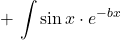 rather than
 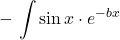 so I have to put the (-) sign back in. Our final result, then, is:
![\[ -\int_0^{\prime} \sin x \cdot e^{-bx} = -\frac{1}{1+b^2} \]](https://www.samartigliere.com/wp-content/ql-cache/quicklatex.com-890bbf44cfdcd5c5e0cb6daf136654ad_l3.png "Rendered by QuickLaTeX.com")
![\[ I^{\prime}(b) = -\frac{1}{1+b^2} \quad \text{(7)} \]](https://www.samartigliere.com/wp-content/ql-cache/quicklatex.com-3cb1830c129f26c0538fe2c01aa90cae_l3.png "Rendered by QuickLaTeX.com")
We integrate both sides:
![\[ \int I^{\prime}(b) = I(b) = -\int \frac{1}{1+b^2} = -\arctan(b) + C \quad \text{(8)} \]](https://www.samartigliere.com/wp-content/ql-cache/quicklatex.com-76fb34a9680e387a5bca35bd614e03a9_l3.png "Rendered by QuickLaTeX.com")
(To see how to get this result, click here.)
Eq. (3) tells us that:
![\[ I(b) = \int_0^{\infty}\frac{\sin x }{x}\cdot e^{-bx}\,dx \quad \text{(9)} \]](https://www.samartigliere.com/wp-content/ql-cache/quicklatex.com-6b54efce0a7dd103e6e936ec56c85a40_l3.png "Rendered by QuickLaTeX.com")
Thus:
![\[ I(b) = -\arctan(b) + C = \int_0^{\infty}\frac{\sin x }{x}\cdot e^{-bx}\,dx \quad \text{(10)} \]](https://www.samartigliere.com/wp-content/ql-cache/quicklatex.com-f88584ecad6e697dcd0a3f54f7d56f80_l3.png "Rendered by QuickLaTeX.com")
Take the limit as  :
:
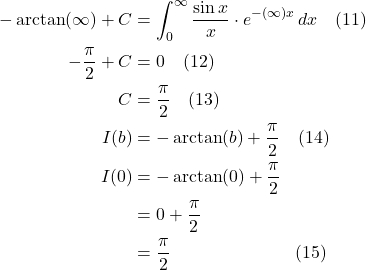
But:
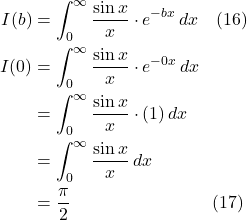
That means that:
![\[ \int_0^{\infty}\frac{\sin x }{x}\,dx = \frac{\pi}{2} \quad \text{(18)} \]](https://www.samartigliere.com/wp-content/ql-cache/quicklatex.com-79a100b086fe0882954c541c8fbdbcf9_l3.png "Rendered by QuickLaTeX.com")