
We wish to prove:
![\[ \int \frac{1}{x^2 + 1}\,dx = \arctan(x) + C \quad \text{(1)} \]](https://www.samartigliere.com/wp-content/ql-cache/quicklatex.com-755efba3c36b4748be912e9f25fa26d8_l3.png "Rendered by QuickLaTeX.com")
We begin by using partial fraction decomposition to re-express the integrand:
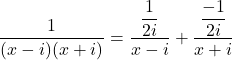
![\begin{align*} \int \frac{1}{x^2 + 1}\,dx &= \int \frac{1}{(x-i)(x+i)}\, dx \quad \text{(2)} \\ &= \int \left[\frac{\displaystyle \frac{1}{2i}}{x-i} + \frac{\displaystyle \frac{-1}{2i}}{x+i}\right]\,dx \quad \text{(3)} \end{align*}](https://www.samartigliere.com/wp-content/ql-cache/quicklatex.com-f26377b06082796673136105466dda4d_l3.png "Rendered by QuickLaTeX.com")
(To see how we came to eq. (3), click .)











![\begin{align*} \int \frac{1}{x^2 + 1}\,dx &= \frac{1}{2i}\int \left( \frac{1}{x-i} + \frac{1}{x+i} \right)\,dx \\ &= \frac{1}{2i}\left[\ln(x-i)-\ln(x+i)\right] + C_1\quad \text{(4)} \end{align*}](https://www.samartigliere.com/wp-content/ql-cache/quicklatex.com-0db66a29985006bb41354605c2b559af_l3.png "Rendered by QuickLaTeX.com")
The next step is to change to polar coordinates. To see how to do this, click .
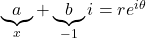


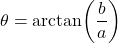

Therefore:
![\begin{align*} \int \frac{1}{x^2 + 1}\,dx &= \frac{1}{2i} [\, \ln(\sqrt{x^2 + (-1)^2}\,e^{\displaystyle i\cdot \arctan(-1/x)}) \\& - \ln(\sqrt{x^2 + (-1)^2}\,e^{\displaystyle i\cdot \arctan(1/x)})\,]+C_1 \\ \\ &= \frac{1}{2i}[\, \cancel{\ln(\sqrt{x^2 + 1})} + \ln(e^{\displaystyle i\cdot \arctan(-1/x)})\\ &- \cancel{\ln(x^2 + 1)} - \ln(e^{\displaystyle i\cdot \arctan(1/x)}) \,] + C_1 \\ &= \frac{1}{2i}\left[ -i\arctan(\frac{1}{x}) - i\arctan(\frac{1}{x}) \right] + C_1\\ &= -\arctan(\frac{1}{x}) + C_1 \quad \text{(5)}\end{align*}](https://www.samartigliere.com/wp-content/ql-cache/quicklatex.com-8adef0be68f4575e9a72baeef27a8d28_l3.png "Rendered by QuickLaTeX.com")
At this point, we need to use the identity:
![\[ \arctan(x) + \arctan(\frac{1}{x}) = \frac{\pi}{2}\quad \text{(6)} \]](https://www.samartigliere.com/wp-content/ql-cache/quicklatex.com-cd73ea97f5cf0ac41dfe5405ea03c5ab_l3.png "Rendered by QuickLaTeX.com")
To see where this comes from, click .
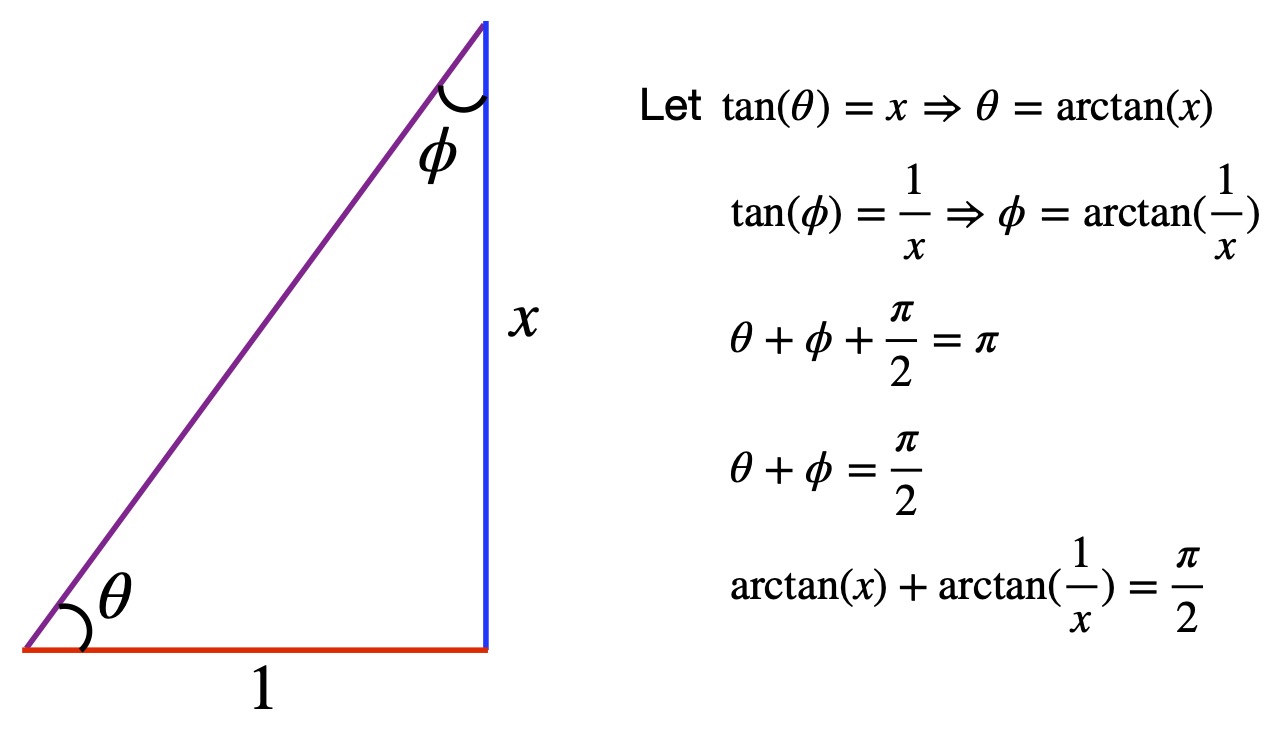
Rearranging eq. (6), we get:
![\[ -\arctan(\frac{1}{x}) = \arctan(x) - \frac{\pi}{2} \quad \text{(7)} \]](https://www.samartigliere.com/wp-content/ql-cache/quicklatex.com-492b46cee7a46433a9d0a129f250d80a_l3.png "Rendered by QuickLaTeX.com")
Now we substitute this into eq.(5):
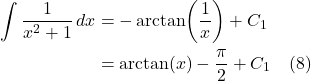
Let
![\[ - \frac{\pi}{2} + C_1 = C \quad \text{(9)} \]](https://www.samartigliere.com/wp-content/ql-cache/quicklatex.com-eb77826fa22380a0ce8e66302f275e1c_l3.png "Rendered by QuickLaTeX.com")
Then:
![\[ \int \frac{1}{x^2 + 1}\,dx = \arctan(x) + C \quad \text{(10)} \]](https://www.samartigliere.com/wp-content/ql-cache/quicklatex.com-422505ac109c5126b48ec3ed4f7f447f_l3.png "Rendered by QuickLaTeX.com")